This website has been developed and funded by Besins Healthcare (UK) Ltd and is intended for patients prescribed Prometrium (progesterone)
400mg soft vaginal capsules in the UK.
The information contained on this page does not replace the patient information leaflet that came with your medicine. For further information,
please consult the patient information leaflet which can be found HERE. Side effect reporting can be found at the bottom of this page.

About Prometrium
The support and advice you need,
when you need it most.
The support and advice you need,
when you need it most.
You’ve been prescribed Prometrium (progesterone) 400mg soft vaginal capsules to support your pregnancy.
We know this journey isn’t easy. That’s why, alongside everything you need to know about your medicine, you’ll also find support and guidance — from how to talk to loved ones and find online communities, to learning about progesterone’s role in early pregnancy — so you can take one step, one day, one heartbeat at a time.
It’s all here, whenever you’re ready.
This website is for patients prescribed Prometrium. Always consult with your medical practitioner if you have any questions regarding your care. Refer to the patient information leaflet that comes with your medicine for further information.
Why have I been prescribed Prometrium?
Your medicine can be used to help reduce the risk of miscarriage in women with bleeding in their current pregnancy and who have a history of 3 or more miscarriages.
What is Prometrium?
Prometrium contains a hormone called progesterone. Progesterone is a key hormone in early pregnancy that helps prepare the uterus lining so an embryo can implant and grow.1,2
For some women with a history of recurrent pregnancy loss, it is thought that increasing progesterone may increase the chance of a live birth.3
It is thought that some women are at risk of miscarriage due to low progesterone levels or reduced sensitivity to progesterone.3 So, for these women, it is also thought that increasing the amount of progesterone may increase the chance of a live birth.3
Why have I been prescribed Prometrium?
Prometrium can be used to help reduce the risk of miscarriage in women with bleeding in their current pregnancy and who have a history of 3 or more miscarriages.
What is Prometrium ?
Prometrium contains a hormone called progesterone. Progesterone is a key hormone in early pregnancy that helps prepare the uterus lining so an embryo can implant and grow.1,2
For some women with a history of recurrent pregnancy loss, it is thought that increasing progesterone may increase the chance of a live birth.3
How to use
Firstly, be sure to read the patient information leaflet inside your Prometrium pack before starting this medicine, as it contains important information that may be relevant to you. You can also download the patient information leaflet here
Your medicine should be taken at the first sign of vaginal bleeding during your first trimester, and you should continue taking it until at least the 16th week of your pregnancy.
- Insert one capsule vaginally twice daily — one in the morning and one at bedtime — or as instructed by your doctor.
- Continue with the same dose until your doctor tells you to stop — this is normally at 16 weeks.
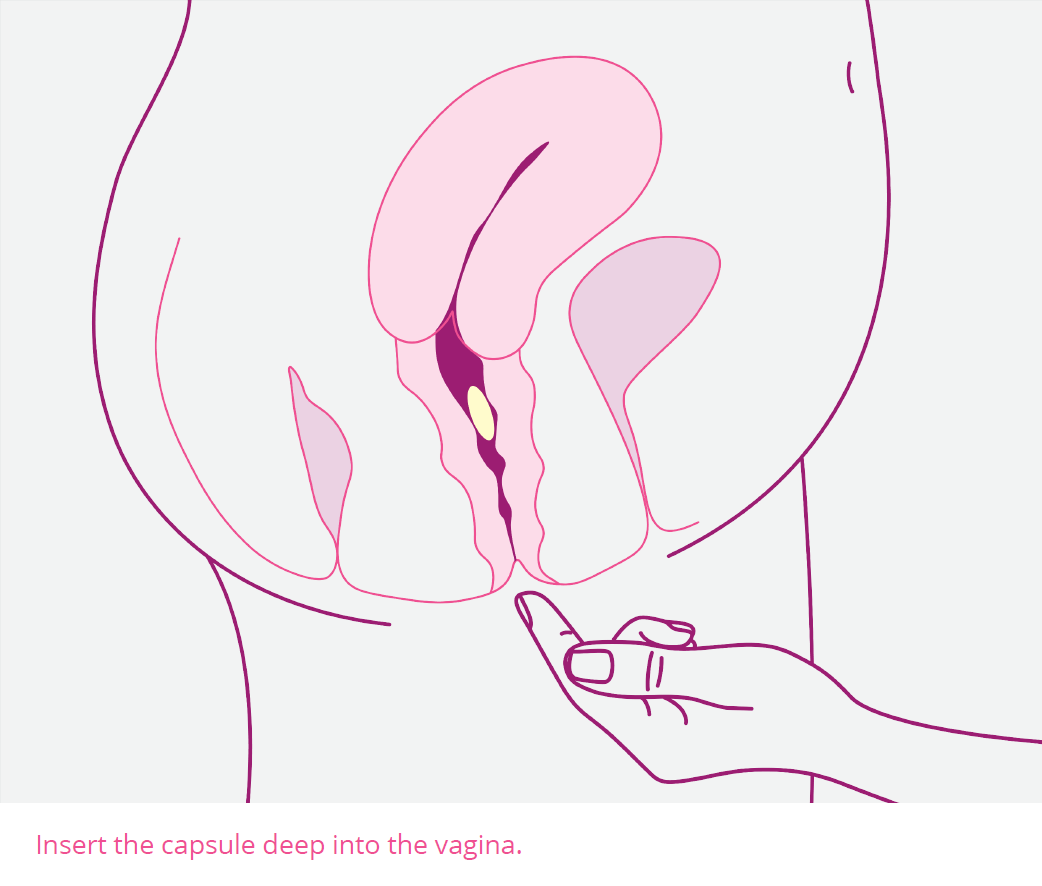
- Insert this medicine deep into the vagina — do not swallow.
If you have any side effects check with your doctor, pharmacist, nurse or midwife.
How to use
Firstly, be sure to read the patient information leaflet inside your Prometrium pack before starting this medicine, as it contains important information that may be relevant to you. You can also download the patient information leaflet here
Your medicine should be taken at the first sign of vaginal bleeding during your first trimester, and you should continue taking it until at least the 16th week of your pregnancy.
- Insert one Prometrium capsule vaginally twice daily — one in the morning and one at bedtime — or as instructed by your doctor.
- Continue with the same dose until your doctor tells you to stop — this is normally at 16 weeks.
- Insert this medicine deep into the vagina — do not swallow
If you have any side effects check with your doctor, pharmacist, nurse or midwife.
Insert the capsule deep into the vagina.
What you need to know before you use Prometrium
Do not use if you have:
- an allergy (hypersensitivity) to soya or peanuts
- an allergy to progesterone or any of the other ingredients of this medicine (listed in section 6 of the patient leaflet inside your Prometrium pack)
- liver problems
- yellowing of the skin or eyes (jaundice)
- undiagnosed vaginal bleeding
- breast cancer or cancer of the genitals
- (or have had) blood clots in a vein (thrombosis), which can sometimes be painful (thrombophlebitis), for example in the leg (deep vein thrombosis) or the lungs (pulmonary embolism)
- (previously had) a cerebral haemorrhage or stroke
- a rare blood disease called porphyria, which is passed down in families (inherited)
Possible side effects
All medicines may cause side effects, although not everybody
gets them. If you do experience any side effects, talk to your doctor, pharmacist or nurse. This includes any possible side effects not listed in the patient information leaflet.
For some people side effects include:4
- Itching or burning sensation
- Oily discharge from the vagina
- Short-term tiredness or dizziness within 1-3 hours of using the medicine
What you need to know before you use Prometrium
Do not use if you have:
- an allergy (hypersensitivity) to soya or peanuts
- an allergy to progesterone or any of the other ingredients of this medicine (listed in section 6 of the patient leaflet inside your Prometrium pack)
- liver problems
- yellowing of the skin or eyes (jaundice)
- undiagnosed vaginal bleeding
- breast cancer or cancer of the genitals
- (or have had) blood clots in a vein (thrombosis), which can sometimes be painful (thrombophlebitis), for example in the leg (deep vein thrombosis) or the lungs (pulmonary embolism)
- (previously had) a cerebral haemorrhage or stroke
- a rare blood disease called porphyria, which is passed down in families (inherited)
Possible side effects
- Itching or burning sensation
- Oily discharge from the vagina
- Short-term tiredness or dizziness within 1-3 hours of using the medicine
Side effects should be reported. If you get any side effects, talk to your doctor, pharmacist, nurse or midwife. This includes any possible side effects not listed in this leaflet. You can also report side effects via the website www.mhra.gov.uk/yellowcard or search for MHRA Yellow Card in the Google Play or Apple App Store. By reporting side effects, you can help provide more information on the safety of this medicine.
References
- Di Renzo, GC et al. Hormone Molecular Biology and Clinical Investigation, vol. 27, no. 1, 2016, pp. 35-48. https://doi.org/
10.1515/hmbci-2016-0038. - Shah D, et al. Indian J Endocrinol Metab. 2013 Jan;17(1):44-9. doi: 10.4103/2230-8210.107834.
- Osmanağaoğlu MA, et al. Journal of Obstetrics and Gynaecology 2010;30:288‐93.
- Electronic Medicines Compendium (eMC) (2024). Prometrium 400mg soft vaginal capsules. Patient Information Leaflet (PIL) Available at: https://www.medicines.org.uk/emc/product/16016/pil#gref Accessed March 2025.

This website has been developed by Besins Healthcare (UK) Ltd. Besins Healthcare is a pharmaceutical company specialising in the development of innovative drugs for the well-being of men and women throughout their life. +44 203 862 0920 | information@besins-healthcare.com
Copyright © 2025 Besins Healthcare. All Rights Reserved. Registered office Lion Court, 25 Proctor Street, Holborn, London, WC1V 6NY, UK.
MAT-PROMO-PTM-0020. April 2025.